

TG Pro 2.104 — Mac version
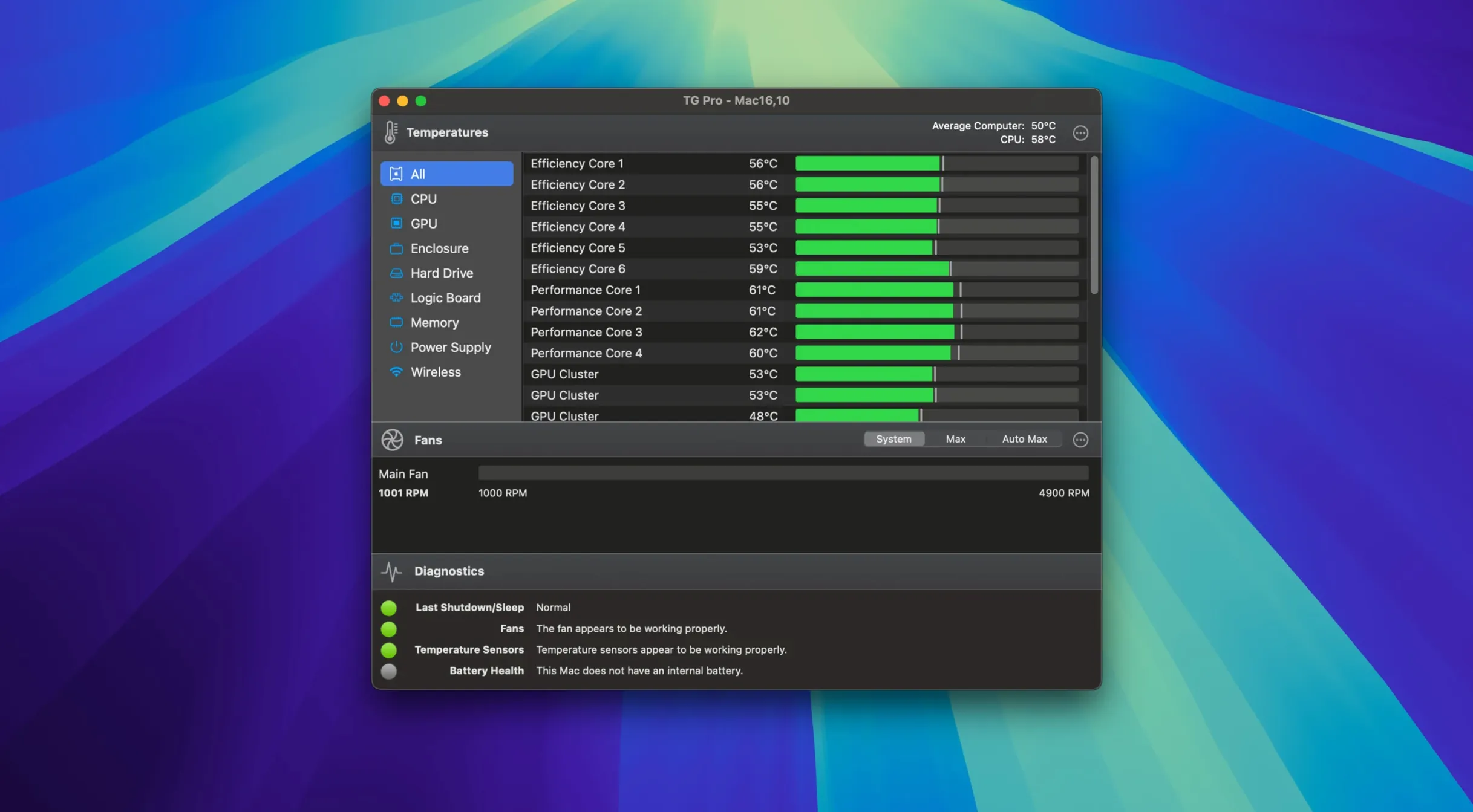
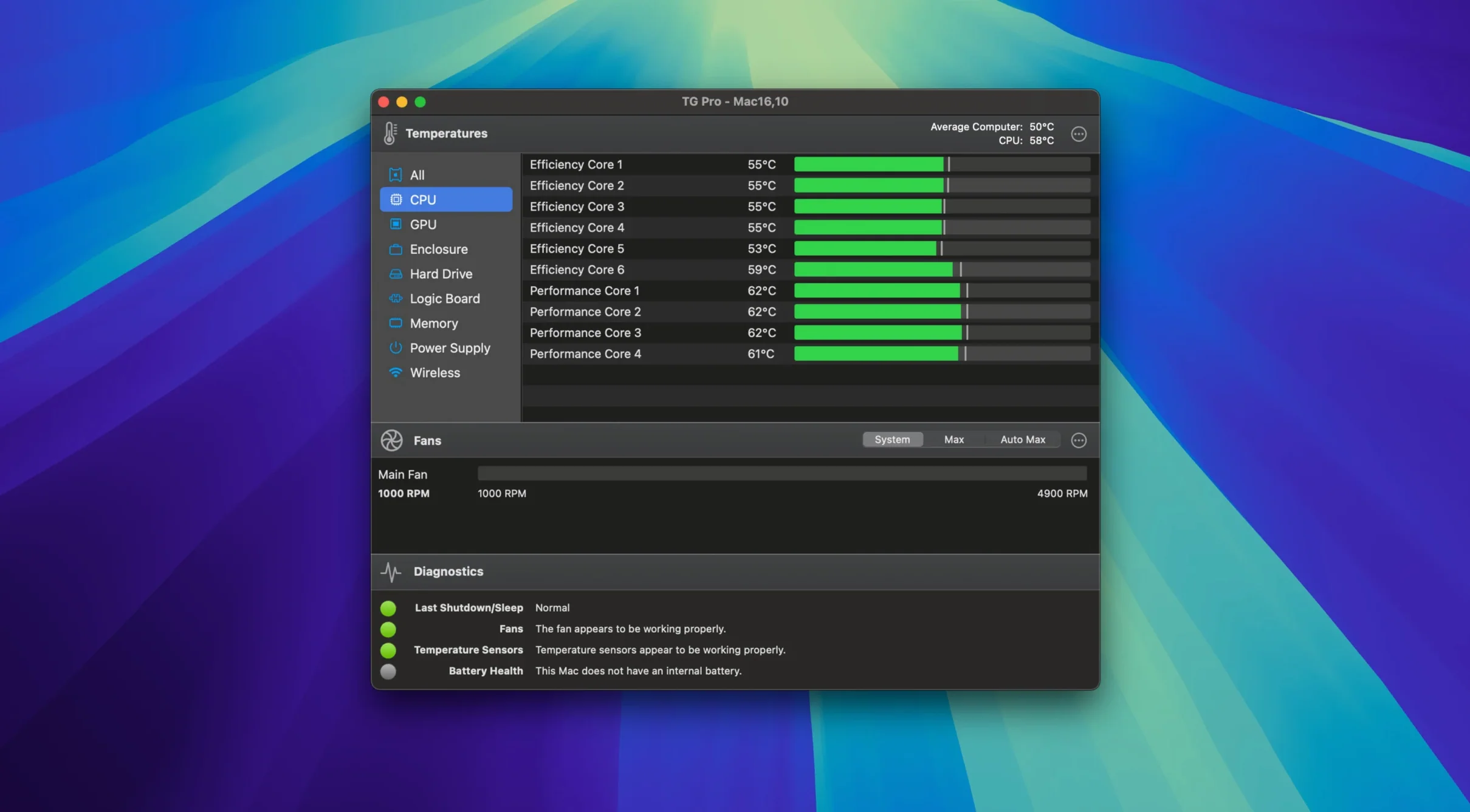
Your Mac gets warm. That's normal. But when the fans spin up for no obvious reason, or worse, stay silent while the keyboard gets toasty, you want to know what's happening inside. TG Pro gives you that view, plain and simple.
It reads the temperature of every component your Mac will report — CPU, GPU, logic board, memory, disks, Wi‑Fi chip, even the battery on a laptop. Then it lets you decide what to do about it.
Spotting a dying fan before throttling starts
- Spotting a clogged fan or dried‑out thermal paste before throttling kicks in
- Keeping an Intel Mac cool under sustained load with custom fan curves
- Watching whether a new M4 machine ever breaks a sweat
- Running a quick diagnostic to rule out a sensor fault
- Logging temperatures in the background while you render or compile overnight
Manual control can hush things too much
- Manual fan control means you can set things too quiet — pay attention to the alerts
- The sheer number of sensors it shows can look intimidating at first
- It sits in the menu bar, so you'll want to set the auto‑boost rules once and forget it
TG Pro plays nicely alongside iStat Menus or Activity Monitor — it's not a dashboard replacement, more a focused tool for when you need to step in. The latest build even restores your fan settings after Siri or dictation grabs the mic, a small fix that makes background use properly hands‑off.
Diagnostic depth Macs Fan Control skips
Macs Fan Control is the one most people mention in the same breath. It is lighter, free for basic use, and does manual fan curves well. Where TG Pro pulls ahead is the diagnostic side — Macs Fan Control shows temperatures but does not log them, does not run a sensor health check, and does not let you build rules tied to specific components. If all you want is "fan faster when CPU hits 80°C," Macs Fan Control does the job. TG Pro earns its place when you need to know why the CPU hit 80°C in the first place.
iStat Menus paints a prettier picture. It covers temperatures, fans, network, disk activity, and a dozen other things in the menu bar. But its fan control is more of a side feature — you get a few presets and a basic slider. TG Pro goes deeper: per-sensor rules, auto-boost triggers that watch multiple components at once, and a logging panel that saves every spike. A lot of people run both — iStat Menus for the glanceable stats, TG Pro for the moments when the fans need a proper talking-to.
Then there is smcFanControl, an old favourite that still works on Intel Macs. It is dead simple, dead light, and dead on Apple Silicon — it never made the jump. If you are on an M1 or newer, it is not an option. TG Pro already covers M4 Max machines with full fan control, so the gap only widens.
Fixes for the first few stumbles
Some things trip people up, and they are usually quick to sort.
Fans ignore manual settings
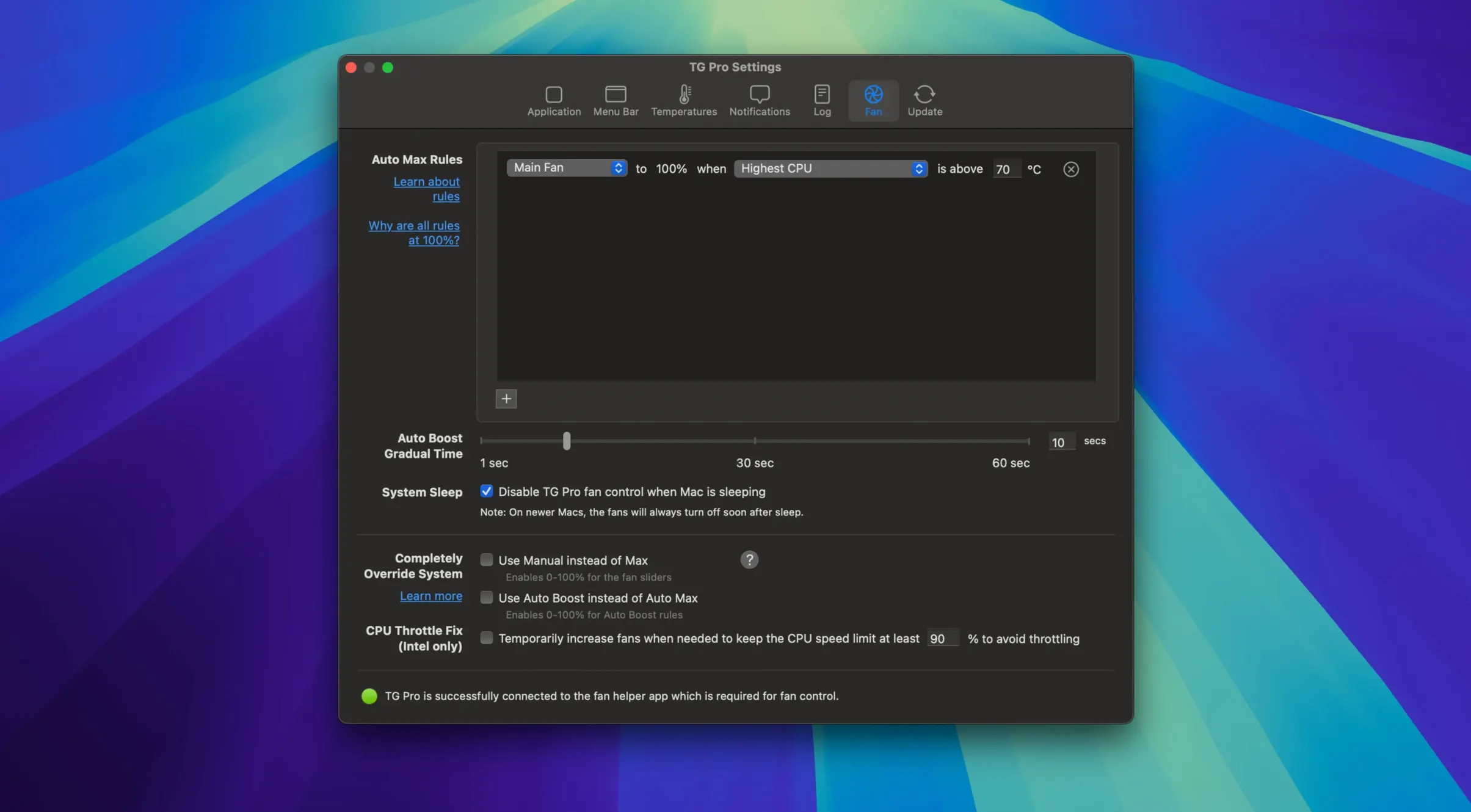
Apple's System Management Controller sometimes overrides third-party tools, especially after a cold boot or waking from sleep. In TG Pro, turn on Auto Boost instead of setting a fixed manual speed. Auto Boost pushes the minimum fan speed up only when a sensor crosses your threshold, which the SMC is far more willing to accept than a permanent "ignore the system" command.
If fans still drift back to system defaults after a few minutes, toggle the Hackintosh preference off and on again — even on real Macs, this can jog the fan control handshake loose. The 2.103 build also fixed a bug where switching between battery and mains would drop the rules, so keeping up to date matters.
Temperature readings seem stuck
A sensor that reads the same value for hours is likely a virtual sensor or a chip that only reports when polled — some SSD controllers behave like this. Run the built-in diagnostic (under the File menu). If it flags nothing, the reading is probably normal. If you want to double-check, drop a heavy load on the machine for five minutes and watch whether the value budges. No movement under load plus a clean diagnostic equals a sensor Apple designed to be sleepy.
Menu bar icon shows the wrong temperature
TG Pro defaults to the hottest sensor, which on a MacBook is often the battery charger chip — it runs warm even at idle. Right-click the menu bar icon, pick Show sensor, and choose something more representative, like CPU proximity or the average across all cores. The change sticks between restarts.
First days with TG Pro
Start with observation, not action. Open the main window and leave it running in the background for a full workday — note which sensors climb under your usual load. On an Intel MacBook, the GPU diode and CPU proximity sensor will likely be the first to complain. On Apple Silicon, the efficiency cores barely register; the performance cluster warms up most during video export or compiling.
Once you have a feel for the baseline, set one auto-boost rule for the component that spikes highest. A good starter rule: if CPU proximity passes 85°C, raise the left fan to 70%. You can add a second rule for the GPU later. Avoid piling on six rules on day one — you will chase your tail adjusting thresholds that overlap.
Turn on logging if you plan to leave a render or batch export running overnight. The log file is plain text and easy to scan the next morning. Look for any temperature that climbed steadily without ever levelling off — that is your cue to clean the vents or re-paste.
If you grabbed a tg pro mac crack to try before committing, double‑check you are running 2.103 — earlier versions had the power‑source bug that dropped rules silently, which can make the tool seem flaky when it is just out of date.
Auto Boost stopped misbehaving when power changes
Version 2.103 is mostly a maintenance release, but a few fixes changed daily use noticeably. The Auto Boost rules failing when switching power sources was a quiet annoyance — plug in the charger, unplug it, and suddenly the fans revert to system defaults. That is sorted now, so the rules stay put whether you are docked or on battery.
Full fan control for M4, M4 Pro, and M4 Max arrived in the same update. Earlier builds could read sensors on those machines but could not command the fans. If you found a TG Pro cracked build that was several versions behind, you missed that entirely. The M4 Max in particular runs its fans independently, so having per‑fan rules working from day one matters for anyone pushing that chip hard.
The fix for Siri and voice dictation is the kind of thing you only appreciate after it is sorted. Before 2.103, using dictation would briefly hand audio control back to the system, and fan settings would sometimes not restore correctly. Now the handshake works cleanly — dictate an email, fans stay where you left them. A small thing, but it stops that moment of "why are the fans suddenly quiet?" when you are mid‑export.
If you are hunting for a TG Pro torrent or a TG Pro Mac crack that includes 2.103, the main thing to watch is that the power‑source fix is baked in — older cracked versions floating around tend to be 2.90 or earlier, and the auto‑boost drop bug will catch you eventually.
- macOS 10.13 or later
- Intel 64-bit Mac








 Back up
Bench talk (0)
Sign in or get a library card to pin up a note.
Nobody has chimed in on this card. If you have used it on an old Mac, say which one.