
Tone Empire EDYN 1.0.2 — Mac version
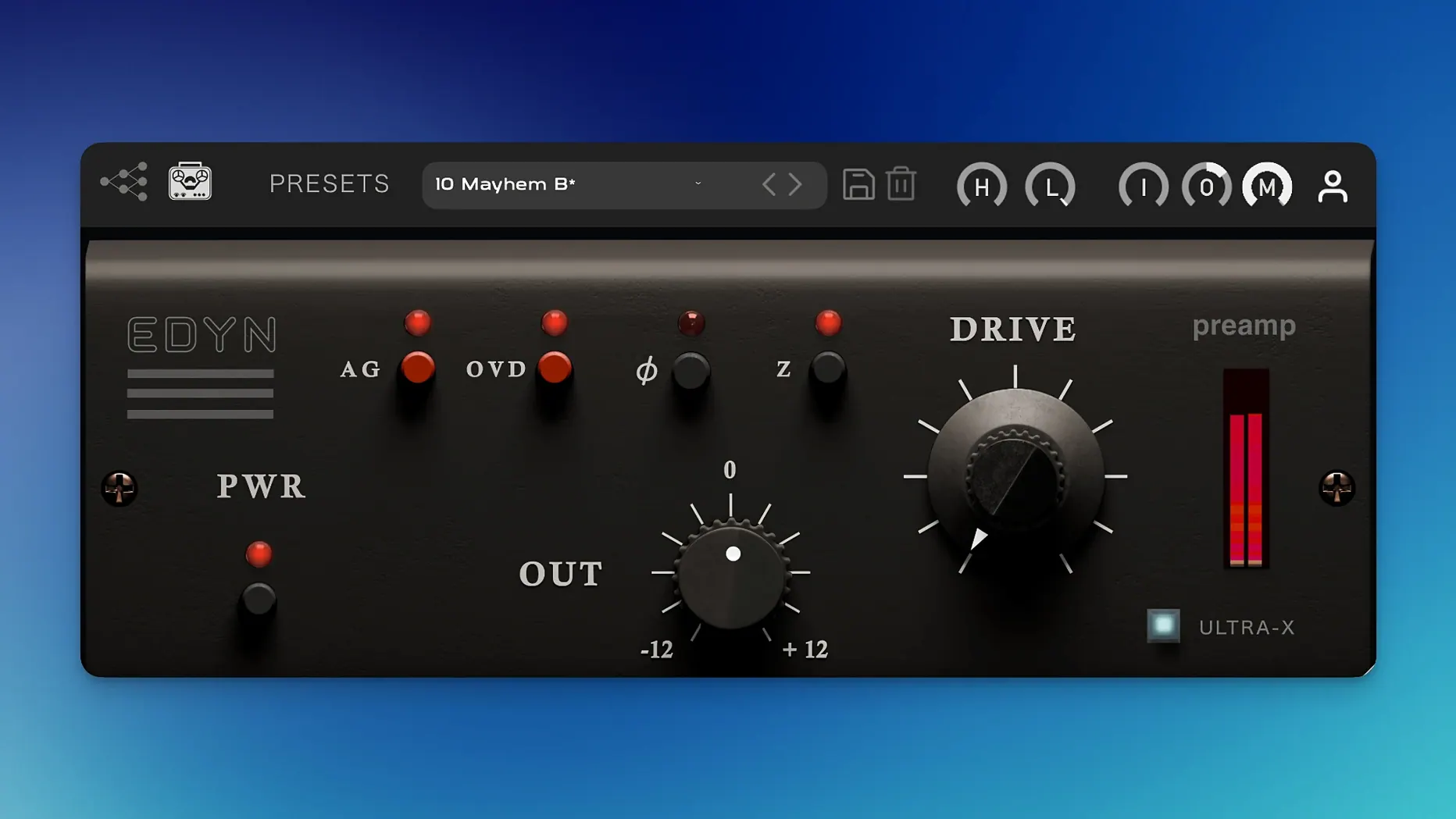
EDYN puts the sound of a late-sixties Electrodyne 1204 console channel into a plug-in you can slot across a whole session.
On individual tracks — push vocals forward with the discrete transistor midrange bite. Kick and snare love the fast transient response; bass DI thickens up without losing its attack.
Across a bus — a touch of Drive glues drums together. The high-pass filter clears out mud before the saturation hits, so the low end stays tight.
On the mix bus — OVD mode adds a little more weight than the standard saturation. Dial the Mix control back to blend the processed signal in parallel, keeping the original dynamics intact while the console tone sits underneath.
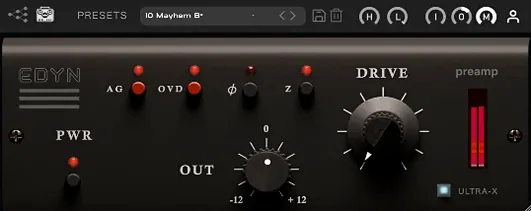
Drive — the saturation stage, from subtle warmth to pushed overdrive.
HPF / LPF — high-pass and low-pass filters for shaping what hits the preamp.
Mix — parallel blend control; useful on buses where you want character without commitment.
OVD — an overdrive mode that takes the tone further than the standard Drive circuit.
Auto gain — automatic gain compensation so loudness stays steady as you push the saturation.
Impedance switch shapes the drive
Open it on a drum bus and the default state already does something. But a couple of tweaks get you further, quicker.
Impedance first. The switch between 50 Ω and 200 Ω isn't a subtle label — it changes how the input stage reacts before anything else touches the signal. On a bass DI or a dull kick drum, 50 Ω tightens the bottom and pulls the transient forward. On a bright acoustic guitar or a harsh hi-hat, 200 Ω softens the attack just enough. Make it the first thing you flick when you drop EDYN on a track.
Auto gain off, then on. Bypass auto gain while you dial in Drive, so you hear what the saturation is really doing. Once the tone sits right, switch it back on and use the Output knob to match levels with the bypass. Your ears won't be fooled by loudness, and the console character stays put.
HPF before Drive. The high-pass filter lives pre-saturation, which means low-end rumble hits the Drive circuit unless you cut it first. On a full mix or a bass-heavy bus, set the HPF around 60–80 Hz before you push Drive. The saturation grabs the mids and highs without chewing up headroom on sub frequencies you'll filter out later anyway.
Use it before a compressor for tone
EDYN isn't a channel strip — it doesn't do compression, EQ beyond the filters, or metering. That's the point. It slots into a chain where you already have those pieces.
Before a compressor on vocals: Drive shapes the tone and evens out the transient peaks a little, so the compressor down the line works less hard. The fast Electrodyne-style response means consonants stay clear even after gain reduction.
After an EQ on drums: boost the midrange with a surgical EQ, then let EDYN's Drive round off the edges. The discrete transistor character adds density without the mud that a tape sim might bring.
With macOS 10.14 or later on Intel or Apple Silicon, EDYN loads as AU, VST3, or AAX. On a machine running Logic Pro on Sequoia, the 1.0.2 update sorted the AU validation hiccups, so it scans clean alongside your other Tone Empire plugs. Multiple instances no longer trip Logic up, and automation lanes in Pro Tools behave properly now — useful when you're riding the Mix control across a chorus.
It also plays nicely with Parallel Aggressor or Loc Ness from the same developer. EDYN on the way in, one of those on a parallel aux — you get the console preamp tone hitting a more aggressive saturation downstream, blended to taste via the Mix knob on each.
Fills the console flavour gap after clean preamps
If you track through clean modern preamps and want a console flavour after the fact, EDYN fills that gap. It suits the producer who records at home with a basic interface — a Focusrite or an Apollo — and wants the push and midrange forwardness of a desk they'll never wire up in real life.
Mixing engineers working on dense rock or indie sessions benefit the most. The fast transient response keeps drums punchy even with Drive pushed, and the OVD mode on a parallel bass chain adds weight that translates on small speakers. Someone mixing electronic music might lean on it for drum bus glue and synth saturation, though the voicing stays firmly in sixties American console territory — it won't do the dark, thick thing a British desk emulation would.
It's less essential if you already run hardware preamps or a summing mixer for colour. And if your template is built around channel-strip plug-ins that do EQ, compression, and saturation in one window, EDYN asks you to think in layers — which is exactly what a preamp stage always did in the analogue world.
- Apple Silicon performance tweaks and lower CPU load
- Fixed offline rendering bugs on the master output
- AU validation sorted for Logic Pro on macOS Sequoia
- Crash fix when running multiple instances in Logic Pro
- Parameter automation now behaves in Pro Tools
- Scalable interface for high-resolution displays
- macOS 10.14 or later
- Intel and Apple Silicon Macs
- VST3, AU, or AAX host
Questions from the bench
What console is EDYN based on?
It's modelled on the Electrodyne 1204, a discrete transistor console from the late 1960s found in American studios.
Can I use EDYN on the master bus?
Yes. Version 1.0.1 fixed offline rendering on the master output, and the Mix control lets you blend the effect in parallel to keep things controlled.




 Back up
Bench talk (0)
Sign in or get a library card to pin up a note.
Nobody has chimed in on this card. If you have used it on an old Mac, say which one.