

AlDente 1.39.4 — Mac version
If you've ever used coconutBattery to check your MacBook's battery health, you know the sinking feeling of watching the cycle count climb while the machine sits plugged in at your desk. AlDente tackles that problem head-on by giving you control over exactly when your Mac stops charging.
The 100% trap for docked MacBooks
- Version: 1.39.4
- Developer: AppHouseKitchen
- macOS: 12 Monterey and later
- Architecture: Apple silicon and Intel
Living with a MacBook that stays docked most of the day means the battery sits at 100% for hours on end — exactly what lithium-ion cells dislike. AlDente lets you peg the charge ceiling at a healthier level, say 70%. The Mac draws power from the charger but simply stops topping up the battery beyond that point. There's also a Calibration Mode for periodically letting the battery cycle fully so the percentage readout stays accurate. It's straightforward, low-fuss, and written with the kind of practical mindset that makes sense in a repair café.
Why Apple's Optimised Charging and AlDente can't both run
One I hear a lot is whether AlDente fights with Apple's own battery management. It doesn't, but you do need to pick your lane. If you leave Apple's Optimised Charging switched on, the two will tug in opposite directions — AlDente trying to hold the limit you set, macOS trying to push past it on its own schedule. The simplest fix is to turn off Apple's battery management in System Settings once AlDente is running. They're both trying to do right by your battery; they just can't share the steering wheel.
Another common worry: does limiting the charge mess up the battery percentage reading over time? This is where Calibration Mode earns its keep. If you keep the battery pegged at 70% for weeks, the Mac's internal guesswork about full capacity can drift. Running a calibration every couple of months — letting it discharge fully, then charge right up to 100% — keeps the readout honest. AlDente doesn't hide this. It puts a calibration button right where you'll see it.
People also ask if this is safe for Apple silicon Macs. Yes. The app talks to the SMC (System Management Controller) the same way Apple's own firmware does. On Intel machines that's straightforward. On Apple silicon, the charge limiting happens through a supported mechanism that doesn't bypass any hardware safeguards. The charge current still goes through the normal charging circuit; AlDente simply tells it when to stop.
The last big question is usually about leaving the Mac plugged in with a charge limit set. Some folk assume the battery is still cycling slightly around the limit point. It isn't. Once the battery hits your ceiling — 70%, 80%, wherever you set it — the charger powers the Mac directly. The battery sits idle, chemically stable, barely ticking up heat or wear. This is the whole point.
Charging bolt appears despite a set limit
Sometimes the menu bar icon shows a charging bolt when you know you've set a limit. That's usually the Mac finishing a top-up above the ceiling because AlDente hadn't loaded fully at startup. Quit the app, reopen it, and the limit should kick in again within a minute. If it doesn't, check that you haven't got Apple's Optimised Charging still active — it's the top offender in support threads.
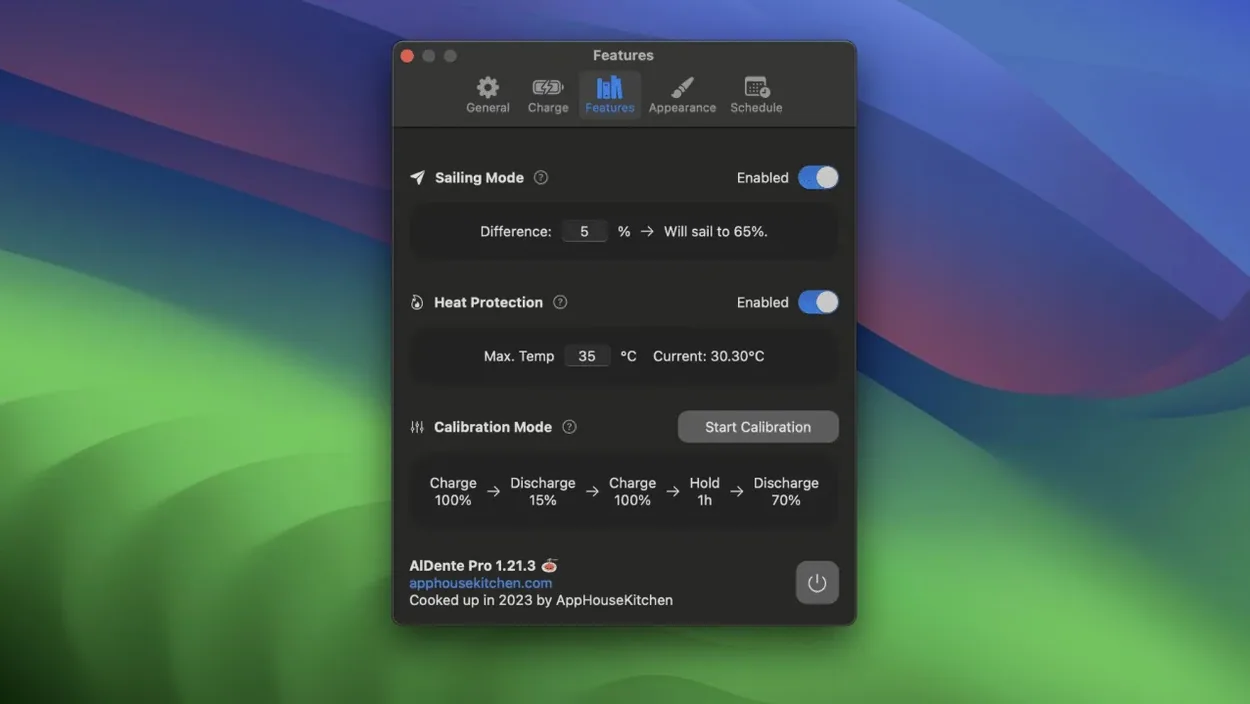
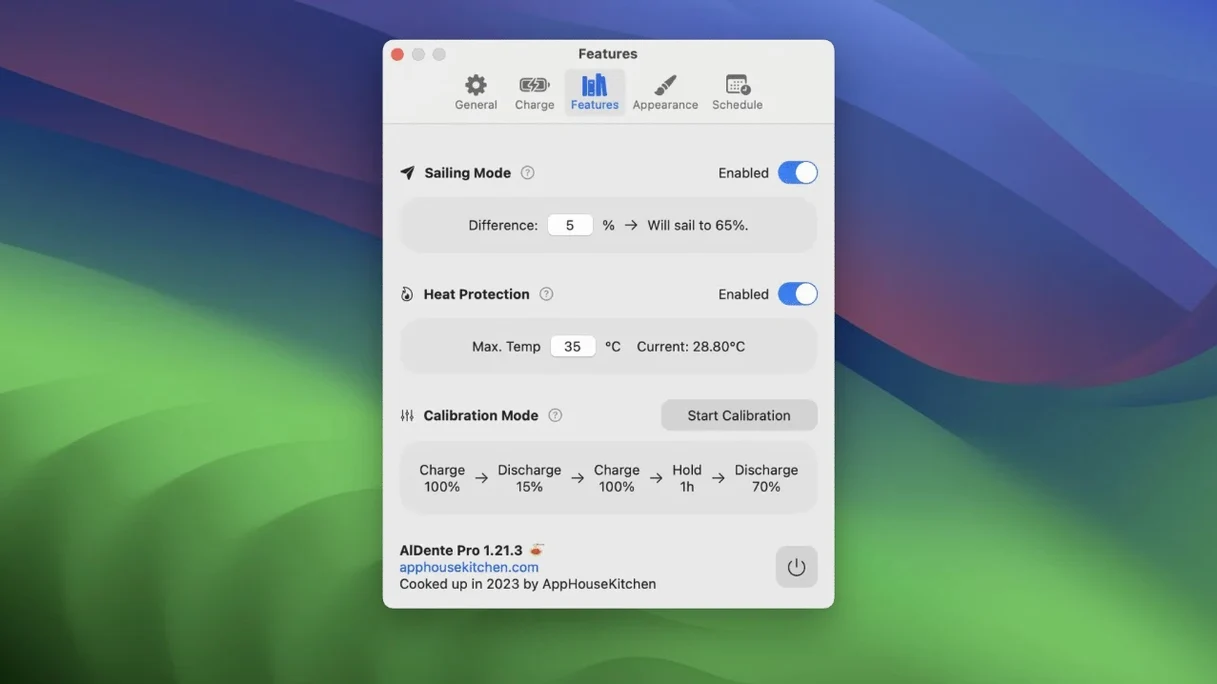
Another occasional hiccup: Sailing Mode doesn't seem to budge the charge level. Sailing Mode lets the battery drift within a small window rather than holding at a fixed percentage — say, letting it drop to 65% then charging back to 70% — so the battery isn't constantly micro-charging. If it looks stuck, check you've set the window wide enough. A 2% band is tight and the movement may be too subtle to notice in an hour. Try 5% and watch it over an afternoon.
Heat Protection triggering unexpectedly catches some people off guard. It pauses charging if the battery temperature crosses a threshold you set. On a hot day or with the Mac running something heavy like HandBrake, that's normal. If it's firing on a cool machine, lower the sensitivity slider a notch. The reading comes straight from the battery's own temperature sensor, so it's accurate — your lap just might not feel the hotspot the sensor sits on.
A rare one: after a macOS update, the charge limit resets and the Mac charges to 100%. New system versions sometimes overwrite the bits AlDente needs to hook into. The developers usually have a fix within days, and re-dragging the app from the disk image over the old copy sorts it. The settings file lives separately so your preferences survive the swap. Some users hunting for aldente pro macos after a system update have spotted the same behaviour — grab the latest build, replace the app, and your limits come back.
Right-click the menu bar icon for instant preset switching
- Right-click the menu bar icon and you can switch between charge limit presets without opening the main window. Useful if you have one for desk days and another for when you know you'll be on battery later.
- The detailed popover readout shows discharge wattage in real time. If you're troubleshooting a machine that drains fast, glance at it under different workloads and you'll spot which app is pulling hard.
- Sailing Mode's window isn't just a number — it shows the current sail direction with a tiny arrow. Charging up toward the upper bound or drifting down toward the lower. Small touch, but it saves mental arithmetic.
- Keyboard shortcut lovers will find that AlDente responds to global hotkeys if you set them in Preferences. You can toggle the charge limit on or off without touching the mouse.
- The status bar percentage can show either the real battery level or the effective charge ceiling. I keep mine on the real level so I know what's in the tank if I unplug suddenly.
From 72% at the repair café: a desk-day charge cycle
Imagine Tuesday morning. You arrive at the repair café at nine, open your MacBook and dock it at the bench. AlDente's menu bar icon sits steady at 72%. You've set the limit to 75%, and overnight it drifted down a few percent in Sailing Mode — exactly as it should. You leave it plugged in all morning while cataloguing donated machines and answering emails. The battery temperature reads 31°C, well within the Heat Protection threshold you set at 35°C.
At lunch, someone asks if you can take the MacBook to the front counter to look up a part number. You unplug and carry it over. Battery is at 73%, plenty for an hour away from power. Back at the bench, you plug in again. AlDente notices the charger, checks the level against your 75% ceiling, sees it's below, and starts charging. Ten minutes later it's back at 75% and the charging stops. The Mac runs on wall power again.
Mid-afternoon, you remember it's been six weeks since the last calibration. You open AlDente, click Calibration Mode, and confirm. The app lets the battery discharge to 0% — you carry on working while it does — then charges it all the way to 100%, measuring the actual capacity curve as it goes. The process takes a few hours. By evening, it's done. AlDente reports the full charge capacity hasn't changed much, which is reassuring. You switch back to your 75% limit and go home.
This rhythm — set a limit, work plugged in, calibrate occasionally — is what AlDente encourages. It's not flashy. It just means you stop thinking about battery wear and get on with the actual work.
Start at 80%, then nudge it down after a week
Pick a conservative limit to start. 80% is a good beginner number that noticeably reduces wear without making you anxious about runtime if you need to unplug. Give it a week at that level, then nudge it down to 75% or 70% if you find you rarely run on battery anyway.
Turn off Apple's Optimised Charging on day one. This avoids the two systems wrestling and gives you a clean read on whether the limit is working. You can always switch it back later if you uninstall AlDente.
Set Heat Protection to 33°C if your workplace is warm, 35°C if it's air-conditioned. MacBook batteries start to degrade faster above 35°C, but you don't want it tripping on a sunny windowsill when nothing's actually wrong.
Watch the menu bar icon for the first couple of days. You'll learn when your Mac charges and when it idles, and that visual feedback builds trust in the tool. After a week, you'll barely notice it — which is exactly how a good utility should settle in. Users running an AlDente Mac cracked build often say the same: once the limit is dialled in, the app fades into the background and the battery just stays healthier for longer.
Run a calibration in the first fortnight to establish a baseline. Write down the full charge capacity AlDente reports. Check it again in six months. That number is your long-term report card.
- Fixed visual glitches in the Popover that appeared in the early betas of macOS 27.2.
- macOS 12 Monterey or newer
- Apple silicon or Intel MacBook








 Back up
Bench talk (0)
Sign in or get a library card to pin up a note.
Nobody has chimed in on this card. If you have used it on an old Mac, say which one.