

Scaler 3 3.3.2 — Mac version
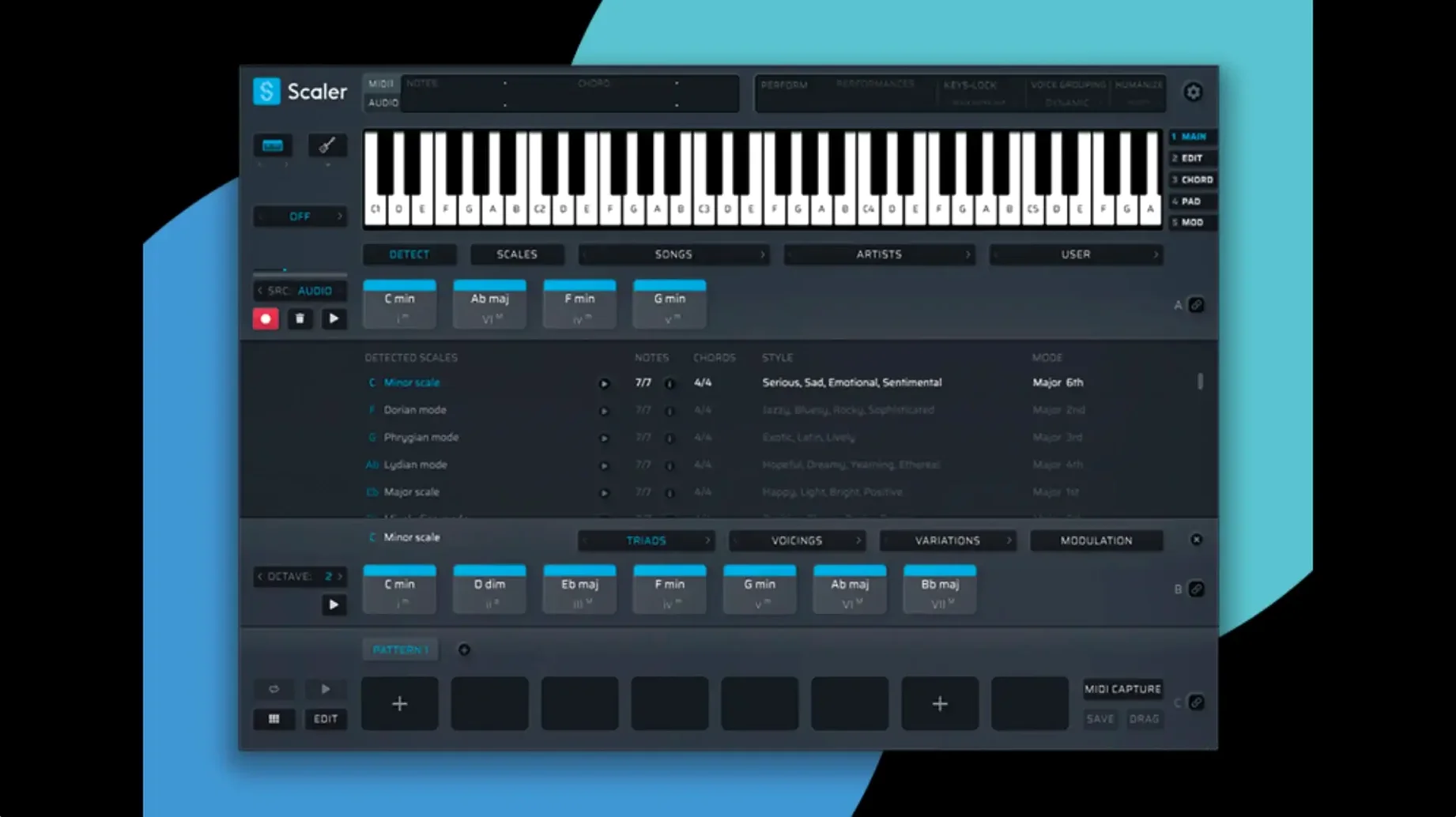
Bedroom producers and gigging keyboardists who want to get unstuck. That's who usually ends up with Scaler 3 open. It's a music theory workstation that runs as a standalone app or a plugin inside your DAW, putting chord progression help and MIDI editing within a few clicks.
Checking formats and hosts
Scaler 3 turns up as VST, VST3, AU and AAX. That covers Logic (AU), Ableton Live (VST3/AU), Pro Tools (AAX) and most other DAWs on a Mac. It's 64-bit only and works on both Intel and Apple Silicon machines, back to macOS 10.15 Catalina.
A quick composing run-through
- Pick a key and find chords. Open the plugin and browse chord sets sorted by artist or genre. Click to audition, drag what you like onto the timeline.
- Build the backbone. The Multi-Lane Timeline holds chord, melody, bass and phrase tracks. Stack a bass line under your chords, then loop it.
- Generate some movement. Hit a preset to create melodies, bass lines or arpeggios in your chosen key. Drag the MIDI out to your DAW when it feels right.
The real utility is in the drag-and-drop workflow. You aren't locked into the plugin's sounds—once the MIDI is in your DAW, it's your instruments, your mix. It's more of a sketchpad that knows its theory.
Late night in a home studio
A producer I know keeps Scaler 3 open while writing toplines for vocalists. She'll pull up a chord set tagged with a mood—say, "wistful" or "driving"—and let it cycle while she hums ideas into her phone. If the verse feels flat, she switches the progression from the artist presets, drags the new MIDI to her piano track, and carries on. No stopping to google chord spellings. The bass lane gets a generated line in the same key so the demo already sounds like a record when she sends it off. It's a keep the tape rolling kind of tool.
The blank MIDI editor glitch and its fix
Scaler 3 does a lot, and a few things trip people up early on.
MIDI editor showing blank space before chords. This was a known display quirk fixed in version 3.3.2. If you're still seeing it, update. The current build crops empty space at the start of exported MIDI too, so your DAW timeline doesn't start with four bars of silence.
Plugin not showing up in your DAW. After installing, rescan your plugins. In Logic, that's a full Audio Unit reset. In Ableton, hold Alt and click Rescan. Still missing? Check you dropped the component (AU) in ~/Library/Audio/Plug-Ins/Components/ and the VST3 in the correct folder. Apple Silicon users running Rosetta mode sometimes need to restart the DAW twice—annoying, but it works.
Dragged MIDI plays back in the wrong octave. Scaler 3 maps chords and bass lines to sensible ranges for auditioning, but your instrument patch might sit an octave higher. Select the MIDI region in your DAW and shift it up or down. Takes two seconds. If it happens often, save a transposed copy of the progression.
Standalone mode won't send MIDI out. The standalone app is brilliant for sketching without a DAW, but you need to route it. Set your MIDI output in preferences to a virtual port (IAC Driver on Mac) and point your synth or sampler at the same port. Old-school, but rock solid.
Captain Chords steers you to its own sounds
Three names come up when producers talk about chord helpers: Scaler 3, Captain Chords, and Ripchord.
Captain Chords lives inside Mixed In Key's ecosystem. It's friendlier looking, with big colourful blocks, but it steers you toward their own sounds. You can drag MIDI out, but it's not as quick. Scaler 3 gives you the Multi-Lane Timeline and plugin hosting on chord lanes—drop a synth right on the track and sculpt the tone before you commit. Captain Chords doesn't host plugins.
Ripchord is a free, lightweight chord mapper. You press one key, it triggers a full chord. Brilliant for performing, but it doesn't suggest progressions or generate bass lines. It's a MIDI router, not a theory brain. Scaler 3 is the other end of the scale: it knows key signatures, suggested voicings, and how a dominant chord ought to resolve. Ripchord is a screwdriver; Scaler 3 is a workbench.
Where Scaler 3 feels weakest is sheer simplicity. If you only need to map single keys to triads, Ripchord loads instantly and costs nothing. If you want glossy presets with less clicking, Captain Chords looks the part. But for core utility—chord discovery, quick harmony editing, multi-lane composition—Scaler 3 is the one that earns its place in a project template.
Shift-click lanes to nudge bass and chords together
- Shift-click to select multiple lanes. Multi-Bind links tracks for editing, but shift-clicking chord and bass lanes together lets you nudge both at once without binding them permanently. Handy when you're trying out timing shifts.
- Right-click a chord block for voicing shortcuts. The context menu gives you inversions, open voicings and drop-2 spreads without digging into a panel. Saves about six clicks every time.
- Drag from the audition button, not just the timeline. You can pull MIDI straight out of the chord suggestion browser. Hear something you like while browsing? Drag the little icon to your DAW immediately—don't bother placing it on the timeline first.
- Standalone mode remembers your last key. If you're looping in standalone and close the app, it reopens with the same progression and key. Less setup means more playing.
- Scaler 3 hosts your soft synths. The plugin hosting on chord and MIDI sections means you can audition progressions through a decent piano or pad instead of the built-in preview sound. Dial in your favourite Kontakt library and browsing becomes properly inspiring.
- Fixed MIDI Editor display glitches where notes could vanish, chord symbols would misbehave, or blank space would appear before chords.
- Exported MIDI now trims empty space at the start of the sequence automatically.
- macOS 10.15 (Catalina) or later
- Apple Silicon or 64-bit Intel processor
- 64-bit host (VST, VST3, AU, or AAX)


 Back up
Bench talk (0)
Sign in or get a library card to pin up a note.
Nobody has chimed in on this card. If you have used it on an old Mac, say which one.